
22 min read
What Is Mewing? The Complete Beginner's Guide
By Mike Mew
• Published on August 11, 2026
Contents
What Is Mewing? The Complete Beginner's Guide
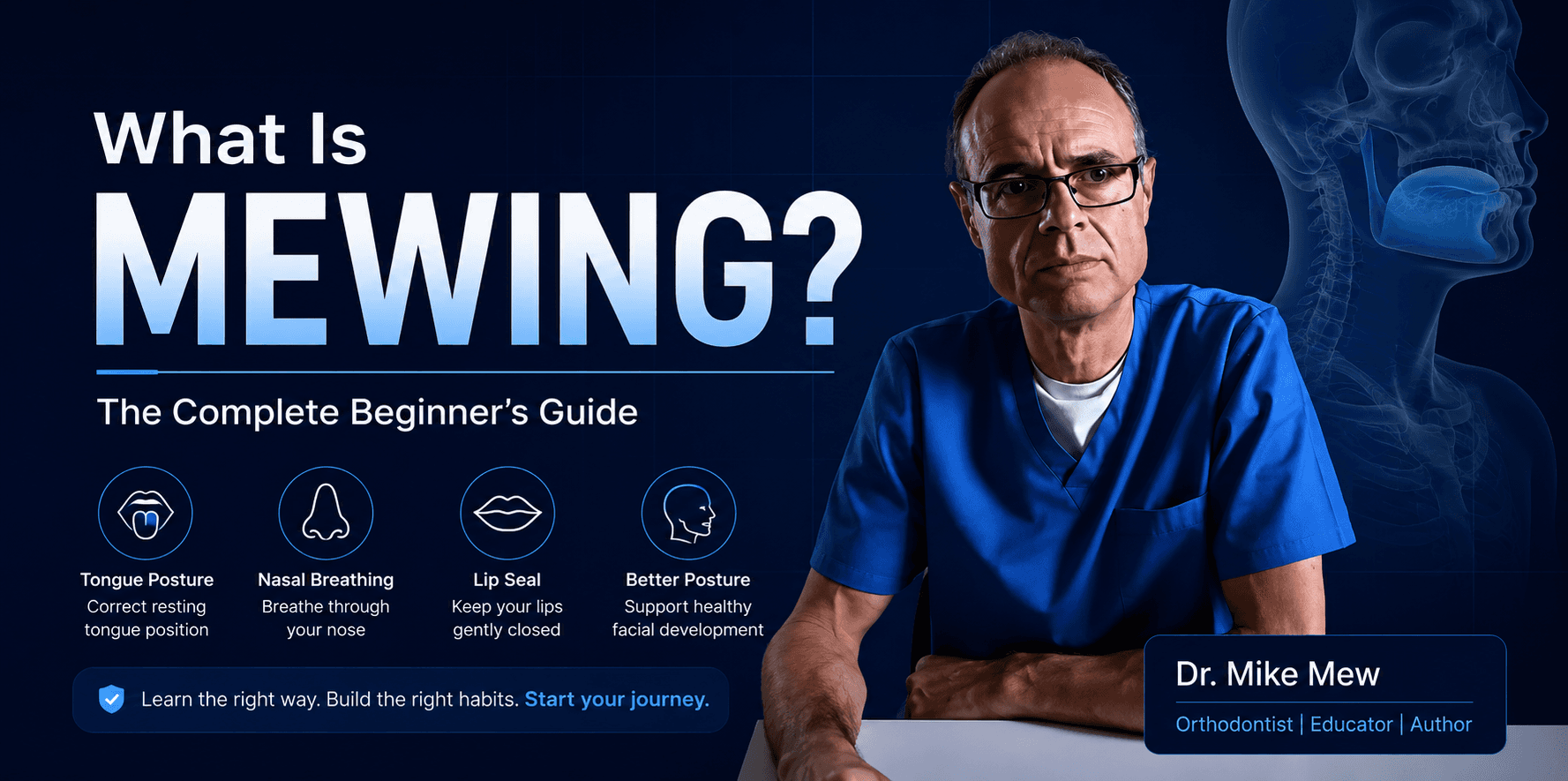
Mewing is the practice of maintaining correct oral posture by resting your tongue against the roof of your mouth while keeping your lips closed and breathing through your nose. Popularised by Dr John Mew and Dr Mike Mew through Orthotropics, mewing focuses on developing healthy oral posture habits rather than providing a quick cosmetic solution. While many people associate mewing with jawline improvement, its foundation lies in correct tongue posture, nasal breathing and long-term consistency.
Key Takeaways
- Mewing is about maintaining correct tongue posture, not forcing your tongue against the roof of your mouth.
- Correct oral posture involves the tongue, lips, breathing and overall head posture working together.
- Mewing should be viewed as a long-term habit rather than a short-term technique.
- Many claims made online about mewing are exaggerated. Understanding the correct technique and setting realistic expectations is essential.
- The Mewing App provides structured lessons, guided exercises and progress tracking to help users develop consistent oral posture habits.
Introduction
Search online for "What is mewing?" and you'll find thousands of videos, social media posts and articles promising dramatic jawline transformations in just a few weeks.
Unfortunately, much of this information is either incomplete or misleading.
Some sources present mewing as a miracle technique capable of reshaping your entire face overnight, while others dismiss it entirely without explaining what mewing actually involves. As a result, many beginners are left confused about what mewing really is, why people practise it and whether it has any genuine purpose.
The reality is more balanced.
Mewing is not simply about pressing your tongue against the roof of your mouth. It is a practice centred on developing correct oral posture through proper tongue position, closed lips and nasal breathing. These habits form part of the broader principles taught through Orthotropics, an approach developed by Dr John Mew and further taught and explained by Dr Mike Mew.
Rather than focusing purely on appearance, the principles behind mewing encourage people to become more aware of their everyday oral posture and breathing habits. Like any habit, this takes time, patience and consistency.
Throughout this guide, we'll explain what mewing is, how it works, the correct tongue position, common mistakes beginners make, realistic expectations and how you can begin learning the technique correctly.
Whether you've just discovered mewing or you're looking for reliable information beyond social media, this guide will provide a clear, evidence-aware introduction to the topic.
Who Is This Guide For?
This guide has been written for anyone who wants a clear, practical understanding of mewing without the myths and misinformation commonly found online.
It is particularly suitable for:
- Beginners who want to understand what mewing actually is.
- Adults interested in improving their oral posture.
- People looking to develop healthier nasal breathing habits.
- Individuals curious about tongue posture and facial development.
- Existing Mewing App users wanting to strengthen their understanding of the fundamentals.
- Anyone looking for an educational resource before starting their mewing journey.
No prior knowledge is required. Everything is explained step by step using simple language while remaining accurate and evidence-aware.
What You'll Learn
By the end of this guide, you'll understand:
- What mewing is and where the concept originated.
- How correct tongue posture differs from simply pressing the tongue upwards.
- Why oral posture involves much more than the tongue alone.
- The role of nasal breathing and lip posture.
- Potential benefits and realistic expectations.
- Common mistakes beginners should avoid.
- How to develop consistent oral posture habits.
- How the Mewing App can help guide your progress.
What Is Mewing?
A Simple Definition
Mewing is the practice of maintaining correct oral posture, where the tongue rests gently against the roof of the mouth, the lips remain gently closed and breathing takes place through the nose.
Unlike a traditional exercise that is performed for a few minutes each day, mewing is intended to become an everyday habit. The goal is to maintain correct posture consistently throughout daily activities such as sitting, standing, walking and periods of rest.
Because it focuses on everyday habits rather than isolated exercises, many people describe mewing as a lifestyle change rather than a technique.
Correct mewing is not about applying excessive pressure with the tongue or constantly thinking about your posture every second of the day. Instead, it involves gradually developing natural oral posture habits that become automatic over time.
What Does "Mewing" Actually Mean?
The term "mewing" comes from the surname of Dr John Mew, the British orthodontist who developed the principles of Orthotropics.
Over time, the term became widely used online to describe the practice of maintaining correct tongue posture.
Today, millions of people associate the word "mewing" with improving facial posture and jawline appearance. However, the original principles extend beyond aesthetics and focus on developing healthy oral posture habits.
Understanding this distinction is important because much of the information shared on social media focuses only on appearance while overlooking the broader concepts of oral posture, breathing and habit formation.
Why Has Mewing Become So Popular?
Over the past decade, mewing has gained significant attention through YouTube, TikTok, Instagram and online discussion forums.
Much of this popularity has been driven by before-and-after photographs, transformation videos and discussions about facial appearance.
While this has introduced millions of people to the concept, it has also created a large amount of misinformation.
Many online creators present mewing as a shortcut to achieving dramatic facial changes in a matter of weeks or months. In reality, the principles behind mewing are centred on developing correct oral posture over time rather than chasing rapid cosmetic results.
This is why it's important to learn the technique from reliable educational resources rather than relying solely on short-form social media content.
The Origins of Mewing
What Is Orthotropics?
Orthotropics is an approach developed by Dr John Mew that focuses on facial growth, oral posture and the relationship between tongue posture, breathing habits and facial development.
Rather than viewing the tongue in isolation, Orthotropics considers how the tongue, lips, jaw, head posture and breathing patterns work together as part of overall oral posture.
The approach places significant emphasis on developing healthy everyday habits rather than relying on occasional exercises.
Although Orthotropics has generated considerable discussion within dentistry and orthodontics, it remains an area where some concepts continue to be debated. Understanding this context is important when reading about mewing, as it helps separate established oral posture advice from broader claims that may require further scientific evidence.
Dr John Mew
Dr John Mew is a British orthodontist who introduced the principles that later became known as Orthotropics.
Throughout his career, he explored the relationship between oral posture, breathing habits and facial development, encouraging greater awareness of how everyday posture may influence long-term oral health.
His work laid the foundation for what would later become widely recognised as "mewing".
Dr Mike Mew
Dr Mike Mew has continued educating people about oral posture and Orthotropics through lectures, educational videos and structured learning resources.
His teaching places strong emphasis on understanding the correct technique, developing consistency and avoiding unrealistic expectations.
One of the key messages throughout this educational approach is that correct oral posture is built through daily habits rather than quick fixes.
This educational approach forms the foundation of the Mewing App, where users can learn correct techniques through structured lessons, guided exercises and progress tracking designed to encourage long-term consistency.
How Does Mewing Work?
Mewing works by encouraging correct oral posture. Rather than being a single exercise, it involves maintaining the correct position of the tongue and lips while breathing through the nose throughout the day.
One of the biggest misconceptions about mewing is that it involves pushing the tongue as hard as possible against the roof of the mouth.
It doesn't.
Correct mewing is based on posture rather than force.
Think of it in the same way as standing with good posture. You don't constantly push your shoulders backwards with maximum effort. Instead, you gradually develop a natural posture that becomes comfortable over time.
Mewing follows the same principle.
The goal is to allow the tongue to rest naturally against the palate while maintaining relaxed lips, a relaxed jaw and nasal breathing.
When these habits become consistent, correct oral posture becomes something you do naturally rather than something you consciously think about every minute of the day.
Consistency is therefore far more important than intensity.
Many beginners mistakenly believe pressing harder will produce faster results. In reality, excessive force can create unnecessary tension and may lead to poor technique.
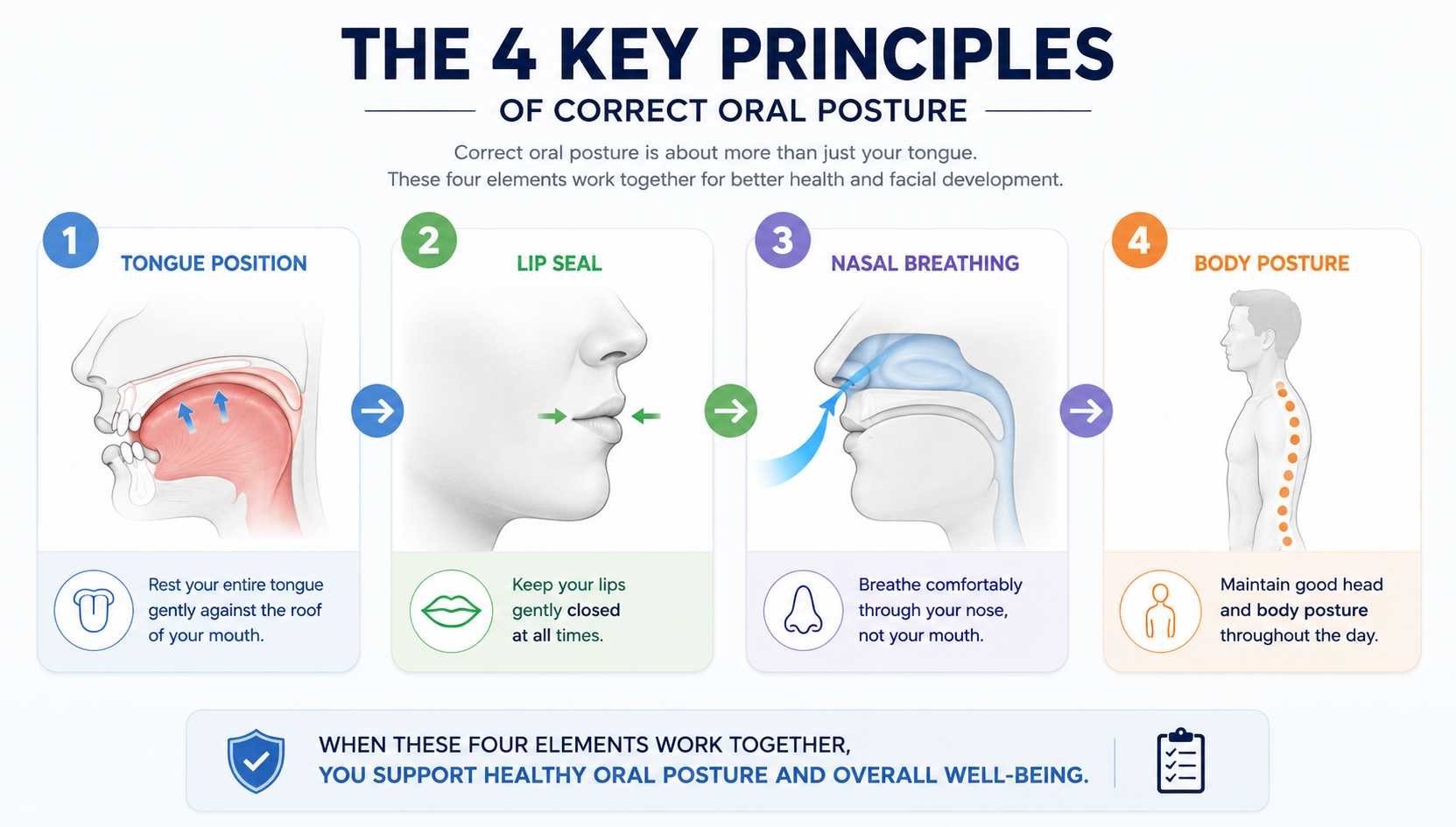
The Five Principles of Correct Mewing
Correct mewing is built around several simple principles that work together.
Tongue Position
The tongue should rest gently against the roof of the mouth.
Ideally, as much of the tongue as comfortably possible should contact the palate, including the back portion of the tongue.
This should feel natural rather than forced.
Lips Closed
The lips should remain gently closed when resting.
There should be no need to squeeze or tense the lips.
A relaxed lip seal complements correct oral posture and nasal breathing.
Nasal Breathing
Breathing should take place through the nose whenever possible.
Nasal breathing is an important component of healthy oral posture and is one of the core principles discussed within Orthotropics.
If nasal breathing is consistently difficult, it may be appropriate to seek advice from a qualified healthcare professional to understand the underlying cause.
Relaxed Jaw
Many beginners unknowingly clench their teeth while attempting to mew.
This is unnecessary.
The jaw should remain relaxed. The teeth may lightly touch or remain slightly apart depending on what feels natural and comfortable. The emphasis should remain on tongue posture rather than jaw tension.
Consistency
This is one of the most important principles.
Correct tongue posture should become an everyday habit rather than something practised for only a few minutes each day.
Small improvements maintained consistently over months and years are more valuable than occasional periods of excessive effort.
Expert Insight
Mewing should not feel like a workout. If you constantly feel strain in your tongue, jaw or neck, you're probably using too much force. Correct oral posture should become comfortable and sustainable over time.
Why Is Correct Tongue Posture Important?
Correct tongue posture is an important part of oral posture because the tongue naturally rests against the roof of the mouth rather than lying low in the mouth.
When people hear the word "mewing", they often focus only on the tongue.
However, the tongue is only one part of the overall picture.
Correct oral posture includes:
- Tongue posture
- Lip posture
- Nasal breathing
- Head posture
- Everyday habits
These elements work together rather than independently.
This is why simply forcing the tongue upwards while continuing to breathe through the mouth does not reflect the broader principles taught through Orthotropics.
The objective is to improve everyday oral posture as a whole.
Tongue Posture vs Mewing
These two terms are often used interchangeably, but they are not exactly the same.
| Tongue Posture | Mewing |
|---|---|
| Refers specifically to the resting position of the tongue. | Refers to the broader practice of maintaining correct oral posture. |
| Focuses on where the tongue naturally rests. | Includes tongue posture, nasal breathing, lip posture and consistency. |
| One part of the overall concept. | The broader approach to developing oral posture habits. |
Mouth Breathing vs Nasal Breathing
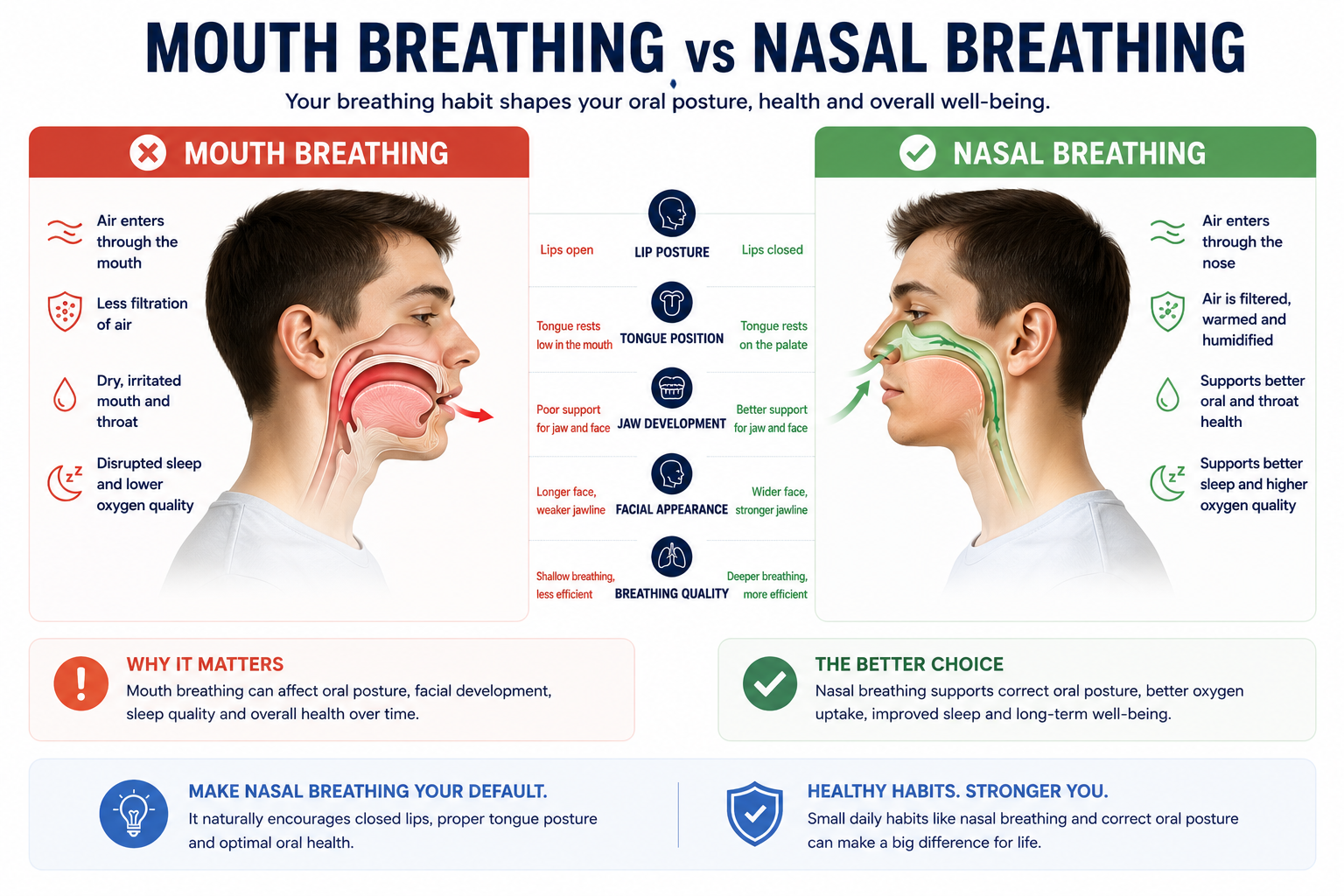
Breathing habits play an important role in oral posture.
Breathing through the nose naturally supports the lips remaining closed and encourages the tongue to adopt its resting position against the palate.
By contrast, habitual mouth breathing often requires the lips to remain open, making it more difficult to maintain correct tongue posture.
This is one reason why nasal breathing is consistently emphasised when learning the fundamentals of mewing.
If persistent nasal obstruction prevents comfortable nasal breathing, it is advisable to seek assessment from a qualified healthcare professional rather than attempting to force the habit.
What Is the Correct Tongue Position?
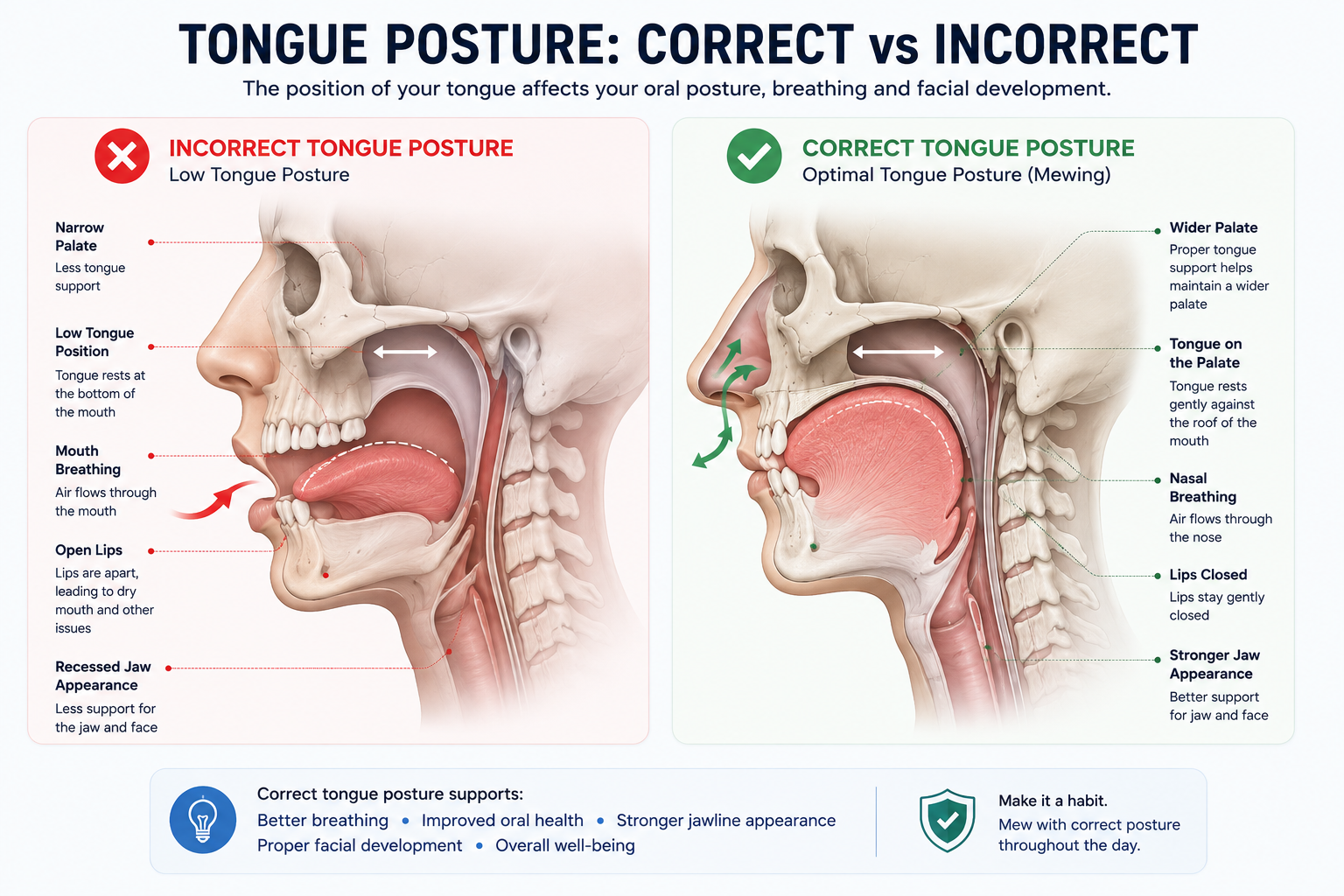
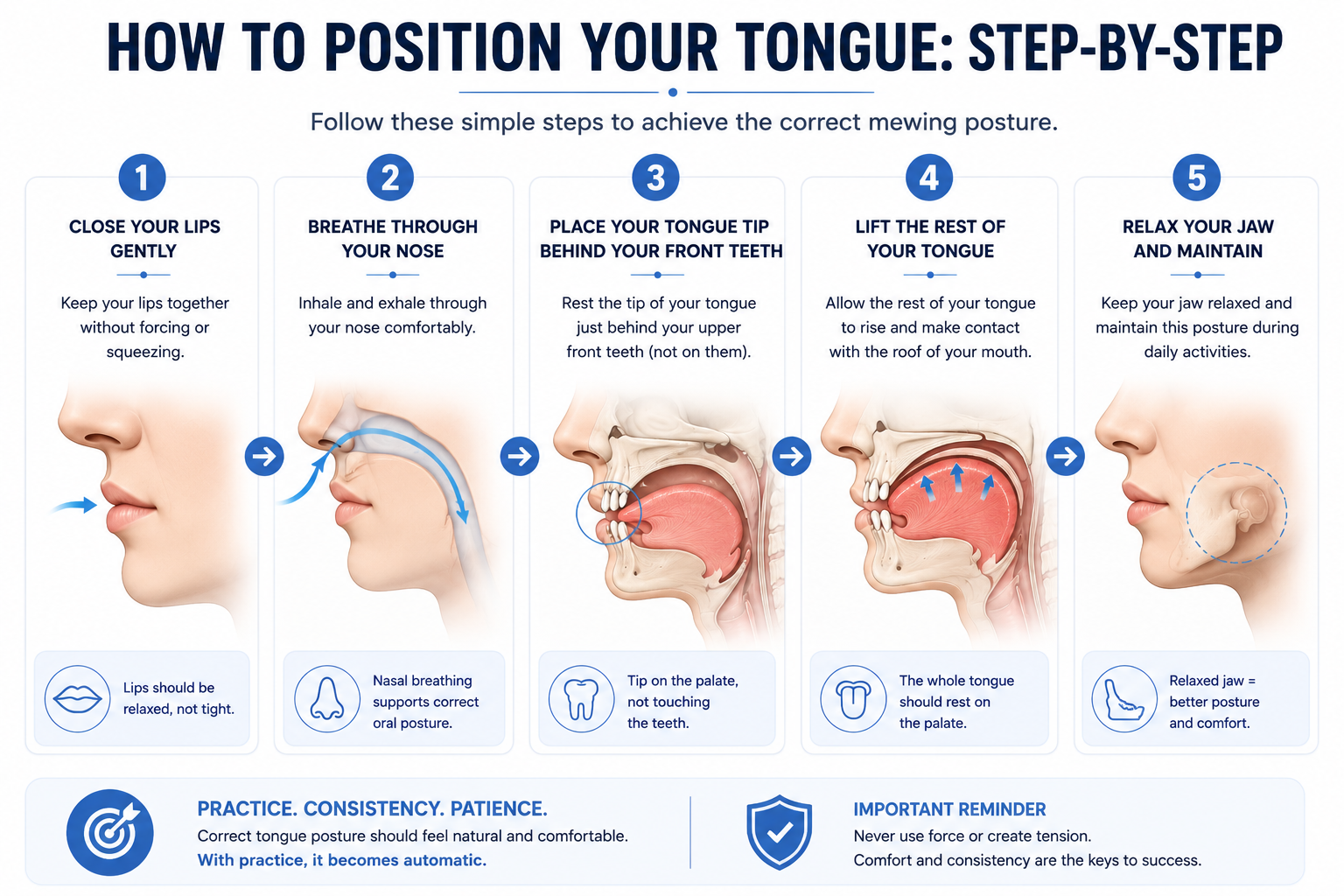
The tongue should rest gently against the roof of the mouth, with the tip positioned just behind your upper front teeth rather than touching them. As much of the tongue as comfortably possible should contact the palate while the lips remain closed and breathing takes place through the nose. The position should feel relaxed rather than forced.
Many beginners struggle because they only lift the tip of the tongue.
In reality, the aim is for the tongue to rest naturally against the palate as comfortably as possible.
The movement should feel gentle and controlled.
You should not experience pain or excessive muscular effort.
Step-by-Step Guide
Step 1: Close Your Lips Gently
Close your lips gently.
Avoid pressing them together tightly.
Step 2: Begin Breathing Through Your Nose
Begin breathing through your nose.
Your breathing should remain relaxed and comfortable.
Step 3: Position the Tip of Your Tongue
Place the tip of your tongue just behind your upper front teeth.
The tongue should not press directly against the teeth.
Step 4: Allow the Rest of Your Tongue to Lift
Allow the rest of your tongue to lift naturally towards the roof of your mouth.
Avoid forcing the movement.
Step 5: Relax Your Jaw
Relax your jaw and maintain this posture naturally during normal daily activities.
With regular practice, this position should become increasingly automatic.
How to Check if You're Mewing Correctly
Ask yourself these simple questions:
- Are my lips gently closed?
- Am I breathing comfortably through my nose?
- Is my tongue resting naturally against the roof of my mouth?
- Does my jaw feel relaxed?
- Am I avoiding unnecessary force?
If you answered yes to each question, you are practising the basic principles correctly.
Common Beginner Mistakes
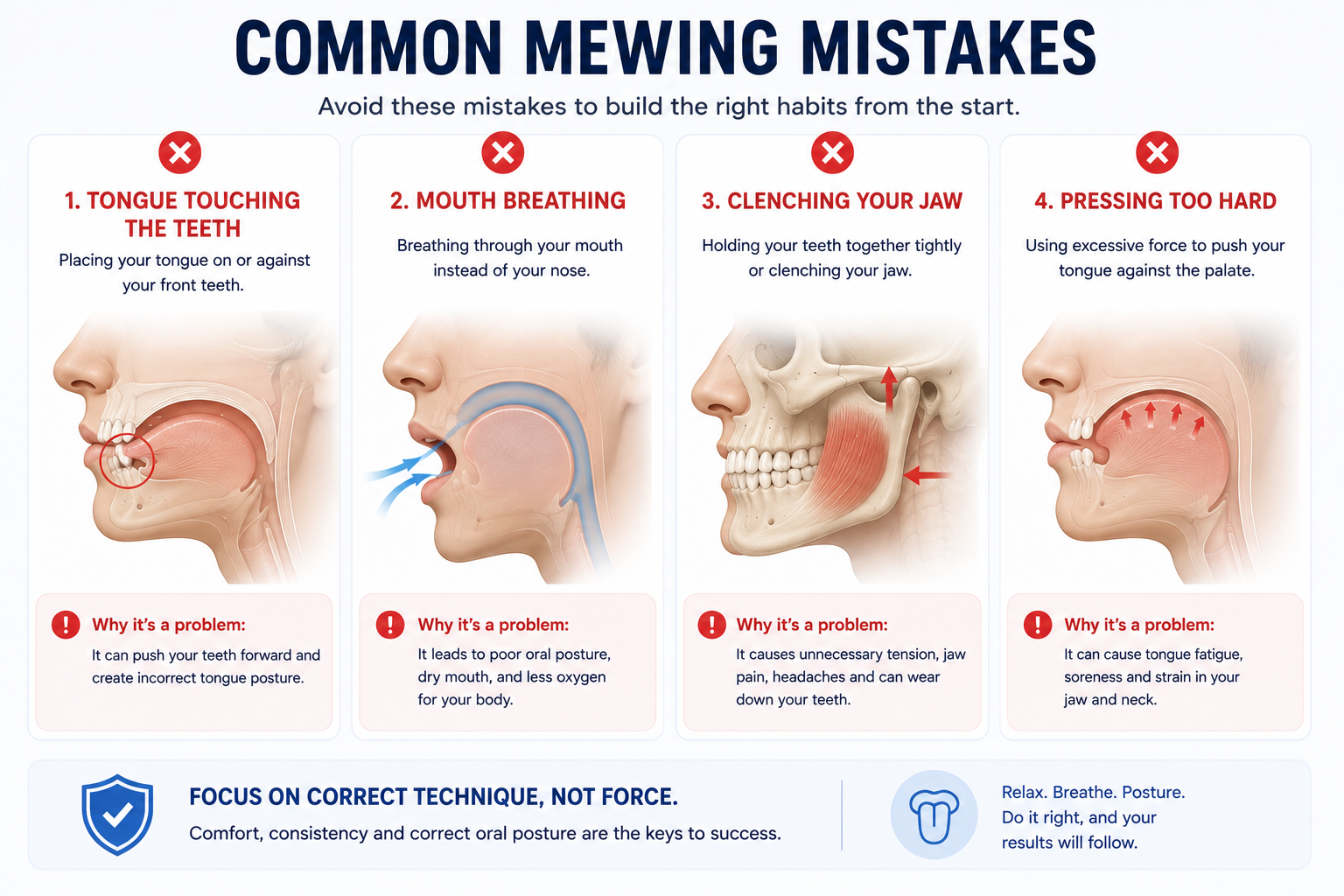
Nearly every beginner makes mistakes when learning mewing.
The good news is that most are easy to recognise and correct.
Pressing Too Hard
More pressure does not produce faster results.
Correct posture is more important than force.
Only Using the Tip of the Tongue
Many people lift only the front of the tongue while leaving the back unsupported.
Aim to maintain comfortable contact across as much of the tongue as naturally possible.
Mouth Breathing
Maintaining correct oral posture becomes more difficult when breathing through the mouth.
Developing comfortable nasal breathing habits is therefore an important part of learning mewing.
Clenching the Jaw
The jaw should remain relaxed.
Mewing is not about tightening facial muscles.
Expecting Immediate Results
Correct oral posture is a long-term habit.
Patience and consistency are far more important than searching for quick changes.
Understanding the Potential Benefits of Mewing
Mewing is primarily about developing healthy oral posture habits. While many people practise mewing with the hope of improving facial appearance, the principles behind mewing focus on correct tongue posture, nasal breathing and long-term consistency. Individual experiences can vary, and not every claimed benefit is supported by the same level of scientific evidence.
One of the reasons mewing has become so popular online is because of the dramatic before-and-after images often shared on social media.
These images frequently focus on facial appearance alone, leading many people to believe that mewing is simply a cosmetic technique.
In reality, mewing is based on the broader concept of developing healthy oral posture habits. While many people report positive experiences, the primary goal is to establish correct tongue posture, maintain nasal breathing and build consistent daily habits.
It is also important to recognise that factors such as age, growth, genetics, lifestyle and individual anatomy all influence facial development and appearance. Mewing should therefore be viewed as one part of a broader approach rather than a guaranteed solution.
Better Awareness of Oral Posture
For many beginners, the first noticeable change is not physical but behavioural.
Learning to pay attention to tongue position, lip posture and breathing helps people become more aware of habits they rarely considered before.
This increased awareness can make it easier to recognise when the mouth is open unnecessarily or when the tongue has dropped away from its natural resting position.
Developing this awareness is an important first step because long-term habits begin with conscious practice.
Developing Better Tongue Posture
Correct tongue posture is one of the central principles of mewing.
Many people naturally rest their tongue low in the mouth without ever thinking about its position.
Mewing encourages users to gradually develop the habit of allowing the tongue to rest comfortably against the palate during everyday activities.
Like any habit, this takes time and repetition.
The goal is not perfection from day one but gradual improvement through consistent practice.
Encouraging Nasal Breathing
Nasal breathing is another key principle discussed throughout Orthotropics.
When breathing comfortably through the nose, it becomes easier to maintain closed lips and consistent tongue posture.
Many people therefore view mewing and nasal breathing as complementary habits rather than separate techniques.
If you regularly struggle to breathe through your nose, it is important to understand why before attempting to force nasal breathing. A qualified healthcare professional can help identify whether an underlying condition requires assessment or treatment.
Facial Development and Appearance
Perhaps the most widely discussed aspect of mewing is its potential influence on facial appearance.
This is also the area where the greatest amount of misinformation exists online.
Facial development is influenced by many factors, including genetics, growth, age and overall health. While discussions around oral posture and facial development continue within dentistry and orthodontics, many of the dramatic cosmetic claims shared online are not supported by strong scientific evidence.
For this reason, mewing should not be viewed as a guaranteed method of changing facial structure.
Instead, it is more appropriate to see it as part of a long-term commitment to healthy oral posture habits.
Setting realistic expectations from the beginning helps avoid disappointment and allows you to focus on developing correct technique rather than chasing rapid visual changes.
Expert Insight
One of the biggest mistakes beginners make is measuring progress only by looking in the mirror. Correct oral posture is a long-term habit. Consistency, proper technique and healthy breathing habits are more important than expecting dramatic visual changes over a short period.
Can Adults Benefit from Mewing?
Adults can learn and practise correct oral posture at any age, although expectations should remain realistic. Adults are primarily developing oral posture habits rather than undergoing the facial growth processes seen during childhood and adolescence.
One of the most common questions asked by beginners is whether it is "too late" to start mewing.
The simple answer is no.
Adults can learn the principles of correct oral posture and begin developing daily habits.
However, it is important to understand the difference between habit formation and facial growth.
Children and teenagers are still growing, meaning facial development follows different biological processes compared with adults. Adults, on the other hand, are primarily developing better posture habits rather than undergoing active facial growth.
This distinction is often overlooked in online discussions.
Rather than comparing yourself with photographs or videos shared on social media, focus on learning the correct technique, maintaining consistency and improving your everyday habits.
Success should be measured by consistency and correct practice rather than by trying to achieve someone else's results.
Children and Adults: What's the Difference?
Although the fundamental principles of oral posture remain the same, children and adults are at different stages of development.
Children are still growing, whereas adults have completed most of their facial development.
This means expectations should be different.
For adults, the emphasis should be on learning correct oral posture, maintaining healthy breathing habits and developing consistency over time.
Why Consistency Matters More Than Age
Whether you are 18 or 58, consistency is one of the most important factors.
Practising correct oral posture for a few minutes each day while forgetting about it for the remaining hours is unlikely to build a lasting habit.
Instead, focus on making correct tongue posture part of your everyday routine.
The more naturally you maintain good oral posture throughout the day, the easier it becomes over time.
Habit formation should always be the priority.
Mewing Myths vs Facts
One of the reasons so much confusion exists around mewing is because social media often presents opinions as facts.
| Myth | Fact |
|---|---|
| Mewing is a quick jawline exercise. | Mewing is about developing correct oral posture as a long-term habit. |
| Pressing harder produces faster results. | Correct technique and consistency are more important than force. |
| Mewing works only for teenagers. | People of all ages can learn oral posture habits, although expectations should differ. |
| Tongue posture is the only thing that matters. | Correct oral posture also includes lip posture, nasal breathing and consistency. |
| Mewing guarantees facial transformation. | Facial appearance is influenced by many factors, and outcomes vary from person to person. |
| You only need to practise for a few minutes each day. | The aim is to develop natural oral posture throughout everyday life. |
| Mouth breathing does not affect mewing. | Nasal breathing is one of the key principles discussed within Orthotropics. |
| Mewing should feel difficult or painful. | Correct posture should feel comfortable and sustainable over time. |
How Long Does Mewing Take?
There is no fixed timeline for mewing because developing correct oral posture is an ongoing habit rather than a short-term exercise.
Many beginners hope for a simple answer such as "30 days" or "three months."
Unfortunately, there isn't one.
Everyone starts from a different point.
Factors such as age, existing habits, consistency, breathing patterns and individual anatomy all influence personal progress.
Instead of asking how quickly results will appear, a better question is:
"Am I practising the correct technique consistently?"
Focusing on habit formation rather than the calendar is a more productive approach.
Like improving your posture or learning a new skill, the greatest value comes from consistency over time.
How the Mewing App Helps You Stay Consistent
Learning the fundamentals of mewing is one thing. Applying them consistently every day is something else.
Many beginners understand the principles but struggle to remember correct tongue posture throughout the day or become unsure whether they are practising correctly.
The Mewing App has been developed to make that learning process easier by providing structured guidance rather than leaving users to rely on scattered information from the internet.
With the app, you can:
- Follow step-by-step lessons designed by Dr Mike.
- Learn the correct mewing technique progressively.
- Build daily consistency through guided routines.
- Track your progress over time.
- Access educational content whenever you need it.
Rather than guessing whether you're on the right track, the app provides a structured learning experience that helps reinforce the principles explained throughout this guide.
Ready to start your mewing journey?
Start your free trial with the Mewing App to access guided lessons, progress tracking and educational content designed to help you build better oral posture habits.
Frequently Asked Questions About Mewing
What is mewing?
Mewing is the practice of maintaining correct oral posture by resting your tongue against the roof of your mouth while keeping your lips closed and breathing through your nose. Rather than being a short exercise, it is intended to become a natural everyday habit. The concept originates from Orthotropics, developed by Dr John Mew and further taught by Dr Mike Mew.
How do you mew correctly?
To mew correctly, gently place your tongue against the roof of your mouth, keep your lips closed, breathe through your nose and maintain a relaxed jaw. Correct mewing should feel comfortable and sustainable rather than forced. The aim is to develop a consistent oral posture habit throughout the day rather than applying excessive pressure.
What is the correct tongue position for mewing?
The tongue should rest naturally against the roof of your mouth, with the tip positioned just behind your upper front teeth rather than touching them. As much of the tongue as comfortably possible should contact the palate while the lips remain closed and breathing takes place through the nose.
Should your teeth touch while mewing?
The important point is that your jaw should remain relaxed and you should avoid clenching your teeth. Different educational resources describe the resting tooth position differently, so comfort and the absence of jaw tension are more important than forcing a particular position.
Should your tongue touch your front teeth?
No. The tip of your tongue should rest on the palate just behind your upper front teeth, not directly against the teeth themselves. Allowing the tongue to press against the front teeth may encourage incorrect tongue posture.
Does mewing actually work?
Mewing is based on the principles of correct oral posture, tongue posture and nasal breathing. Many people report positive experiences with improving these habits, but claims regarding major facial changes remain an area of ongoing discussion and scientific debate. It is important to approach mewing with realistic expectations and focus on developing healthy, consistent oral posture rather than expecting dramatic cosmetic changes.
How long does mewing take?
There is no fixed timeline because mewing is intended to become a permanent oral posture habit rather than a temporary exercise. Progress varies depending on age, existing habits, consistency and individual anatomy. The focus should always be on maintaining correct technique rather than achieving rapid results.
Can adults benefit from mewing?
Adults can learn and practise correct oral posture at any age. However, expectations should remain realistic. Adults are primarily developing healthier oral posture habits rather than undergoing the facial growth processes seen during childhood and adolescence.
Is it too late to start mewing?
No. While facial growth differs between children and adults, it is possible to improve oral posture, tongue position and breathing habits at any age. Developing consistent habits can be useful regardless of when you start.
Can mewing change your jawline?
Facial appearance is influenced by many factors, including genetics, growth, age and lifestyle. Although many people associate mewing with jawline improvement, evidence for significant facial changes in adults remains limited. It is best viewed as an approach to oral posture rather than a guaranteed cosmetic technique.
Is mewing safe?
Mewing should not involve excessive force or pain. If you experience jaw discomfort, breathing difficulties or dental concerns, seek advice from a qualified healthcare professional before making significant changes to your oral posture.
Can mewing improve breathing?
Correct oral posture encourages nasal breathing, which is one of the principles discussed within Orthotropics. However, if you experience persistent nasal blockage or difficulty breathing through your nose, consult a healthcare professional to identify and address the underlying cause.
Can mewing help with mouth breathing?
Mewing promotes nasal breathing and keeping the lips gently closed, both of which support healthy oral posture. However, mouth breathing can have underlying causes such as allergies or nasal obstruction. Addressing the underlying cause is important before attempting to change long-term breathing habits.
What happens if I mew incorrectly?
Incorrect technique may lead to unnecessary tension in the tongue, jaw or neck and can reinforce poor posture habits. Common mistakes include pushing the tongue against the front teeth, using excessive force, clenching the jaw and breathing through the mouth.
Should I mew while sleeping?
Correct oral posture is intended to become a natural habit throughout the day. As your tongue posture and breathing habits improve while you are awake, maintaining a healthier resting posture during sleep may become easier. If you suspect you breathe through your mouth during sleep, it is worth investigating the reason rather than trying to force the habit.
Can I still talk while mewing?
Yes. Mewing describes your natural resting oral posture. When speaking, eating or drinking, your tongue and mouth will move normally before returning to their natural resting position afterwards.
Should I chew gum while mewing?
Chewing and mewing are different concepts. Mewing focuses on oral posture, while chewing primarily involves the jaw muscles. If you choose to chew gum, it should not replace learning correct tongue posture or maintaining healthy breathing habits.
Do I need jaw exercisers or special devices?
No. Mewing is based on developing natural oral posture habits rather than relying on external devices. Consistency, correct technique and education are more important than purchasing gadgets or jaw-training equipment.
How can I tell if I'm mewing correctly?
A simple checklist is helpful: your tongue should be resting comfortably against the palate, your lips should be gently closed, you should be breathing through your nose, your jaw should feel relaxed, and you should not be pushing your tongue against your front teeth or using excessive muscular effort.
What's the easiest way to learn mewing correctly?
Learning from a structured educational programme is easier than relying on short social media videos or conflicting online advice. The Mewing App provides step-by-step lessons, guided exercises, progress tracking and educational resources designed to help users build correct oral posture habits consistently over time.
Final Thoughts
Mewing is often presented online as a quick way to change your appearance, but understanding the underlying principles gives you a much more useful perspective.
At its core, mewing is about developing correct oral posture and making healthier habits part of everyday life. That means learning where your tongue should rest, keeping your lips gently closed, breathing comfortably through your nose and avoiding unnecessary tension.
It is also important to keep expectations realistic. Facial development and appearance are influenced by many factors, and dramatic promises made online should be treated with caution.
If you're starting out, focus first on learning the technique correctly. Then work on making it consistent.
The goal is not to force your tongue into position for a few minutes and then forget about it. The goal is to develop a natural resting posture that becomes easier and more automatic over time.
Start Your Mewing Journey Today
The most important part of learning mewing isn't finding another video or article. It's developing the correct technique and practising it consistently.
If you'd like structured guidance from Dr Mike, daily lessons and progress tracking, start your free trial with the Mewing App today.

Mike Mew
Mike Mew is the British founder of mewing, known for his innovative approach to improving facial structure and oral posture naturally. He is a leading pioneer of Orthotropics, an approach developed by his father, Professor John Mew.
Related posts
29 min read
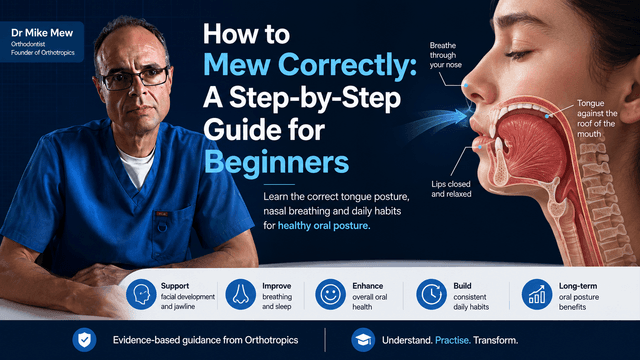
How to Mew Correctly: A Step-by-Step Guide for Beginners
Learn how to mew correctly with this practical step-by-step beginner's guide covering tongue position, jaw and lip posture, nasal breathing, common mistakes, daily habits and frequently asked questions.
By Mike Mew

3 min read
The Great Mewing Event
Dr. Mike Mew has officially announced The Great Mewing Event, set to take place on 6th September at Logan Hall.
By Mike Mew
2 min read
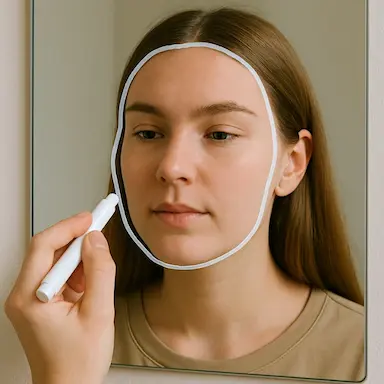
Gesichtsformen einfach erklärt: So findest du deine!
Deine Gesichtsform hilft dir dabei, den besten Haarschnitt, die passende Brille oder das richtige Make-up zu finden. In diesem Artikel zeigen wir dir Schritt für Schritt, wie du deine Gesichtsform bestimmst – ganz einfach!
By Henry
