
29 min read
How to Mew Correctly: A Step-by-Step Guide for Beginners
By Mike Mew
• Published on August 24, 2026
Contents
How to Mew Correctly: A Step-by-Step Guide for Beginners
Quick Answer
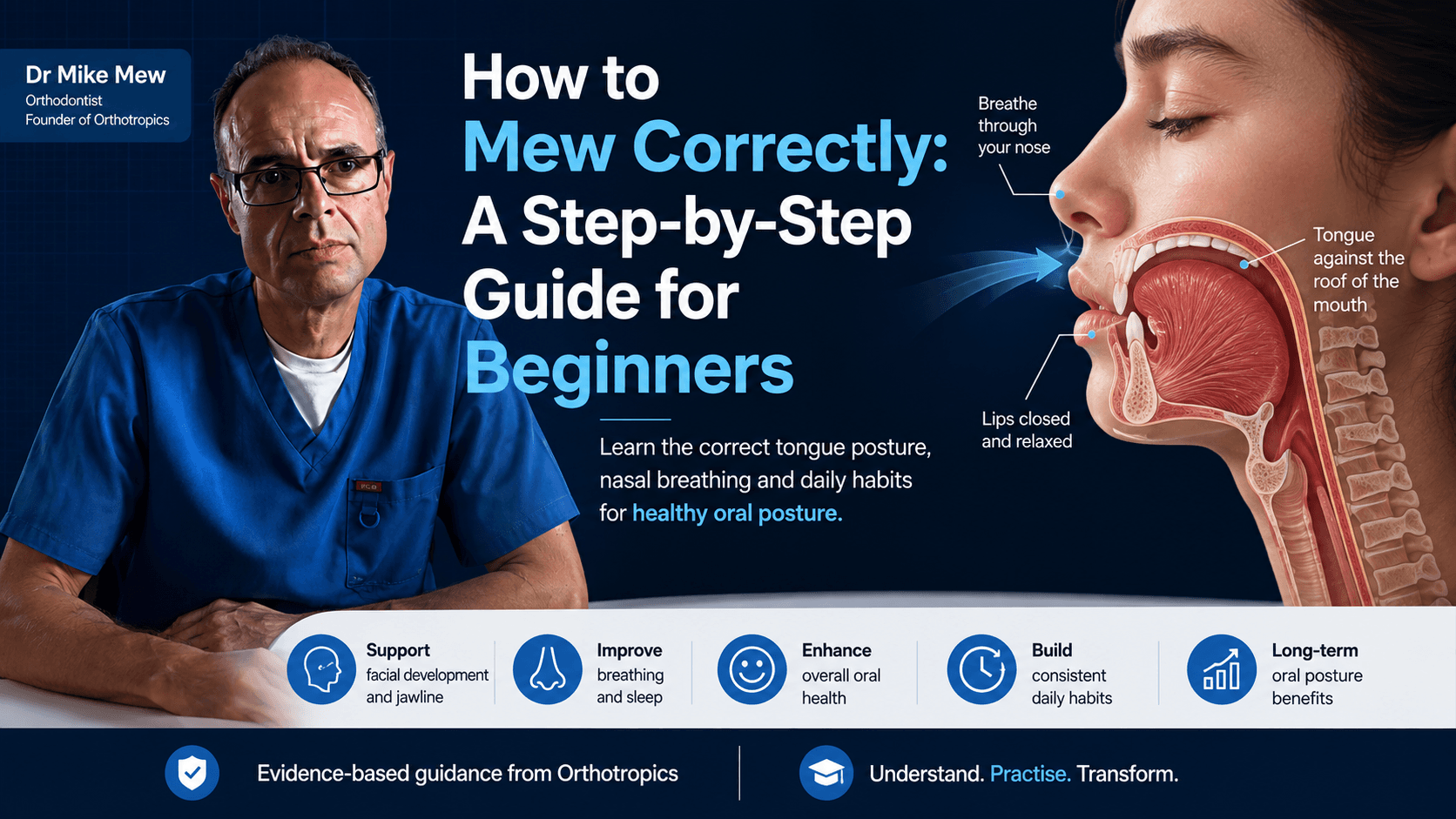
To mew correctly, start with a relaxed jaw and gently closed lips, then position your tongue against the roof of your mouth with the tip resting behind your upper front teeth without pressing against them. Breathe comfortably through your nose and avoid excessive force. The aim is to develop a natural resting posture through consistent practice rather than treating mewing as a strenuous exercise.
Key Takeaways
- Mewing is primarily about developing correct oral posture, not pushing the tongue as hard as possible.
- The tongue should rest against the palate as comfortably as possible, including the middle and back portions.
- The tip of the tongue should sit behind the upper front teeth rather than pushing against them.
- Your lips should remain gently closed without unnecessary tension.
- Nasal breathing is an important part of the overall posture.
- Clenching your jaw or forcing your tongue into position is not the goal.
- It can take time for the position to feel natural, so consistency is more important than intensity.
Introduction
Knowing what mewing is and knowing how to do it correctly are two different things.
Once people understand the basic idea of mewing, the next question is usually much more practical:
Where exactly should my tongue go?
This is where many beginners become confused.
Search online and you will find instructions telling you to push your tongue against the roof of your mouth, hold it there all day, press harder or even perform different forms of "hard mewing". You may also find completely different explanations about where your teeth should sit, how much pressure to use and whether you should be able to breathe normally while holding the position.
That confusion is understandable.
Correct oral posture is not something most people are consciously taught. You may have been resting your tongue in the same position for years without ever thinking about it.
The purpose of this guide is therefore not to tell you to simply "push your tongue up".
It is to show you how to find a comfortable resting position, understand what each part of the posture is doing and recognise the common mistakes that can make the process unnecessarily difficult.
Most importantly, mewing should not be treated as a competition to see how much pressure you can apply.
The aim is to develop a natural, sustainable oral posture that you can maintain without unnecessary strain.
If you are completely new to mewing, start with our guide to W+hat Is Mewing? The Complete Beginner's Guide before continuing. It explains the origins of mewing, Orthotropics and the principles behind the practice in more detail.
Before You Start: What Correct Mewing Should Feel Like
Before worrying about the exact position of your tongue, it helps to understand what you are actually trying to achieve.
Correct mewing should feel relaxed, controlled and sustainable.
It should not feel like you are performing an intense tongue workout.
Mewing Is a Resting Posture, Not a Workout
One of the most common misunderstandings is that mewing means actively pushing the tongue upwards for as long or as hard as possible.
That approach misses the main idea behind oral posture.
The tongue is a muscular structure, but mewing is primarily concerned with its resting position.
Think about your general body posture.
If you are sitting correctly, you do not need to consciously squeeze every muscle in your back throughout the day. You are aiming for a position that is balanced enough to maintain naturally.
The same principle applies here.
You are learning where your tongue should rest and gradually becoming more aware of your oral posture. With practice, the position should require less conscious effort.
Gentle Positioning Matters More Than Force
There is no advantage to turning mewing into a test of strength.
If you find yourself pressing your tongue extremely hard against your palate, tightening your jaw or creating tension in your neck, stop and reset.
A good starting principle is simple:
Find the correct position first. Then work on making it natural.
Do not start by trying to create maximum pressure.
What You Should Not Feel
Mewing should not cause pain.
You should not need to:
- Clench your teeth.
- Force your jaw into a particular position.
- Push your tongue painfully against the palate.
- Press your tongue against your front teeth.
- Hold your breath.
- Strain your neck or facial muscles.
If practising the position causes persistent jaw pain, dental discomfort or other symptoms, stop forcing the technique and speak with an appropriate healthcare professional.
How to Mew Correctly: Step-by-Step
Now let's go through the basic process.
Do not worry if the position feels unfamiliar at first. Your tongue may have been resting differently for years, so learning to recognise a new position can take practice.
Step 1: Relax Your Jaw
Start with your jaw relaxed.
Do not clench your teeth or deliberately tighten the muscles around your jaw.
Let your face settle into a comfortable resting position.
The purpose of this first step is to remove unnecessary tension before you concentrate on your tongue.
Take a normal breath and allow your jaw to relax.
You are not trying to create a dramatic change in your facial position.
You are simply establishing a comfortable starting point.
Step 2: Close Your Lips Gently
Bring your lips together without squeezing them.
Your lips should be closed in a relaxed way rather than tightly pursed.
If you have developed a habit of keeping your mouth slightly open, this may initially require some awareness.
Do not force your lips together if doing so creates discomfort.
The aim is a gentle lip seal that can be maintained comfortably.
Step 3: Find the Position of Your Tongue Tip
Now bring your attention to the tip of your tongue.
The tip should rest on the palate behind your upper front teeth.
It should not be pushing directly against the teeth.
This distinction is important.
A common beginner mistake is to place the tongue against the back of the upper front teeth and then push forwards. That is not what you are trying to achieve.
Instead, think about placing the tip just behind the teeth and allowing the rest of the tongue to follow upwards.
Step 4: Bring the Middle of Your Tongue Up
Once you have found the position of the tongue tip, focus on the middle of your tongue.
Allow it to rise towards the roof of your mouth.
This is where many beginners discover that they have been focusing only on the front of the tongue.
The aim is not to create a narrow, tense tongue.
Instead, allow the tongue to spread comfortably against the palate.
You should be able to maintain the position without feeling that you are fighting against your own muscles.
Step 5: Learn to Engage the Back of Your Tongue
The back portion of the tongue is often the most difficult part for beginners to recognise.
You may feel the front of your tongue touching the palate but have little awareness of what the back is doing.
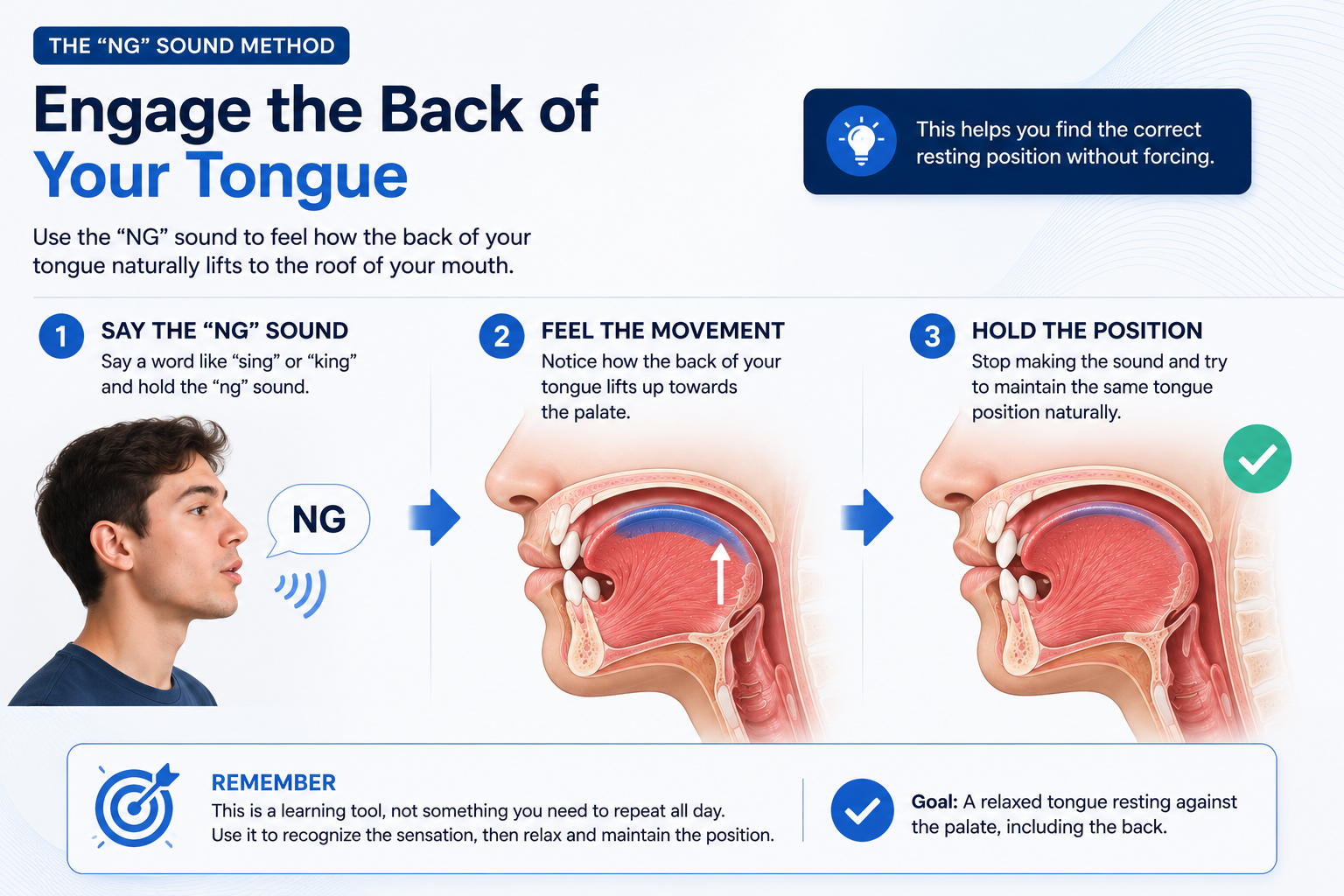
One commonly used way of finding this position is the "NG" sound.
Say a word such as:
sing
Pay attention to what your tongue does when you reach the final "ng" sound.
That movement can help you identify the general sensation of the back of the tongue moving upwards.
Once you have identified the position, stop making the sound and see whether you can maintain a similar resting position naturally.
Do not force the back of your tongue upwards simply because you cannot feel it clearly.
This is something that can become easier with practice.
Step 6: Breathe Through Your Nose
Once your tongue and lips are positioned comfortably, breathe through your nose.
Your breathing should remain calm and comfortable.
You should not feel as though your tongue is blocking your airway.
If you cannot breathe comfortably through your nose, do not simply force the tongue higher or hold the position while struggling to breathe.
Persistent difficulty breathing through the nose can have many possible causes and may need to be assessed by a qualified healthcare professional.
Mewing should never involve deliberately restricting your breathing.
Step 7: Maintain the Position Without Excessive Effort
Once everything is in place, relax.
Your:
- Tongue should be comfortably positioned against the palate.
- Lips should remain gently closed.
- Jaw should remain relaxed.
- Breathing should remain comfortable through the nose.
Now comes the most important part:
Do not obsess over holding the position perfectly every second of the day.
You will probably lose the position at first.
That's normal.
When you notice that your tongue has dropped, simply reset it.
Over time, repeated awareness and practice can make the position feel more familiar.
How to Find the Correct Tongue Position
Finding the position once is relatively easy.
Learning to recognise it consistently is more difficult.
The "NG" Sound Method
The "NG" method is one of the simplest ways for beginners to become aware of the back portion of the tongue.
Say:
sing
or:
king
and hold the final "ng" sound for a moment.
Notice where your tongue moves.
You should feel the back portion of your tongue moving upwards towards the palate.
Now stop making the sound while attempting to maintain a similar tongue position.
Remember that this is a learning method, not something you need to repeat continuously throughout the day.
The objective is simply to help you recognise the position.
Where Should the Tip of the Tongue Rest?
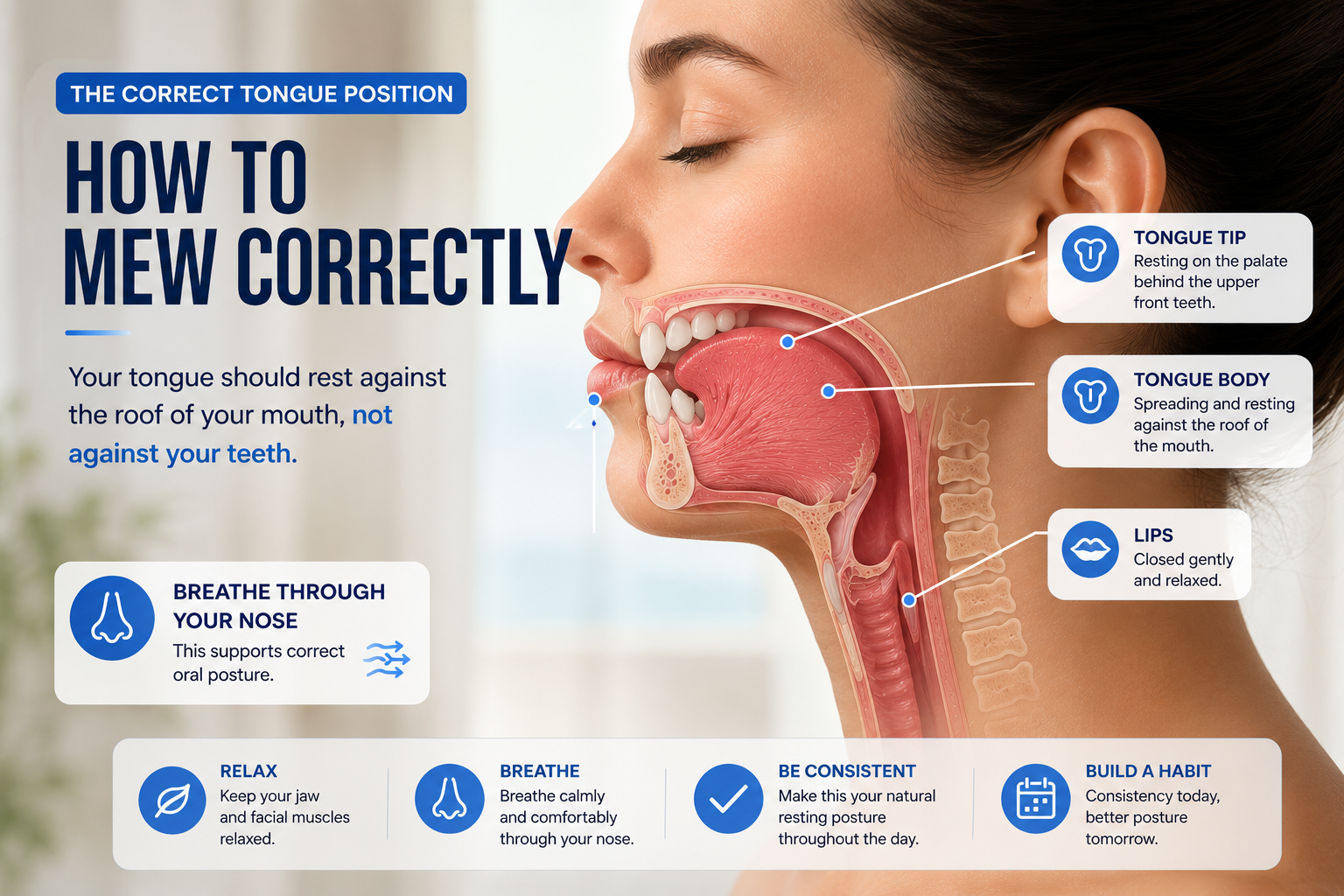
The tip should rest on the palate behind the upper front teeth.
It should not press against the front teeth.
If you find yourself pushing the tongue forwards into your teeth, relax and move the tip slightly backwards.
The position should feel stable without creating pressure against the teeth.
What About the Middle of the Tongue?
The middle portion should also be raised towards the palate.
This is important because mewing is not simply about placing the tongue tip in one location.
If only the tip is raised while the rest of the tongue remains low, you are not developing the full resting position you are trying to learn.
Focus on allowing the tongue to spread naturally against the roof of the mouth rather than creating a narrow or tense shape.
What About the Back of the Tongue?
This is usually the hardest part for beginners.
You may not immediately know whether the back of your tongue is in the correct position.
That is completely normal.
Use the "NG" sound to become familiar with the sensation, then gradually work towards maintaining the position without consciously forcing it.
Do not confuse awareness with force.
You do not need to feel a dramatic upward pressure at the back of your tongue for the technique to be useful as a posture-learning exercise.
How Much of the Tongue Should Touch the Palate?
The general principle taught in the Mewing App's educational material is that the tongue should rest against the palate across as much of its surface as can be achieved comfortably, with particular attention to the posterior portion.
However, beginners should not become fixated on achieving a perfect sensation immediately.
If you are currently unable to maintain the full position comfortably, start by becoming familiar with the basic tongue-up posture and gradually improve your awareness.
The goal is to learn the position correctly, not to force your tongue into a position that feels painful or unnatural.
What Should Your Teeth Do When Mewing?
This is one of the questions that causes the most confusion online.
The most important point is:
Do not clench your teeth.
Your jaw should remain relaxed.
Different educational sources describe the exact resting relationship between the upper and lower teeth somewhat differently, so it is better not to force a particular tooth position simply because you have seen it demonstrated online.
What matters most for a beginner is avoiding excessive jaw tension and deliberately pushing the teeth together.
If you already have orthodontic treatment, significant bite problems or jaw discomfort, do not attempt to change your bite through mewing on your own. Speak to your dentist or orthodontist about your individual situation.
Mewing and Nasal Breathing
Correct tongue posture and breathing are closely connected when learning the basic principles of mewing.
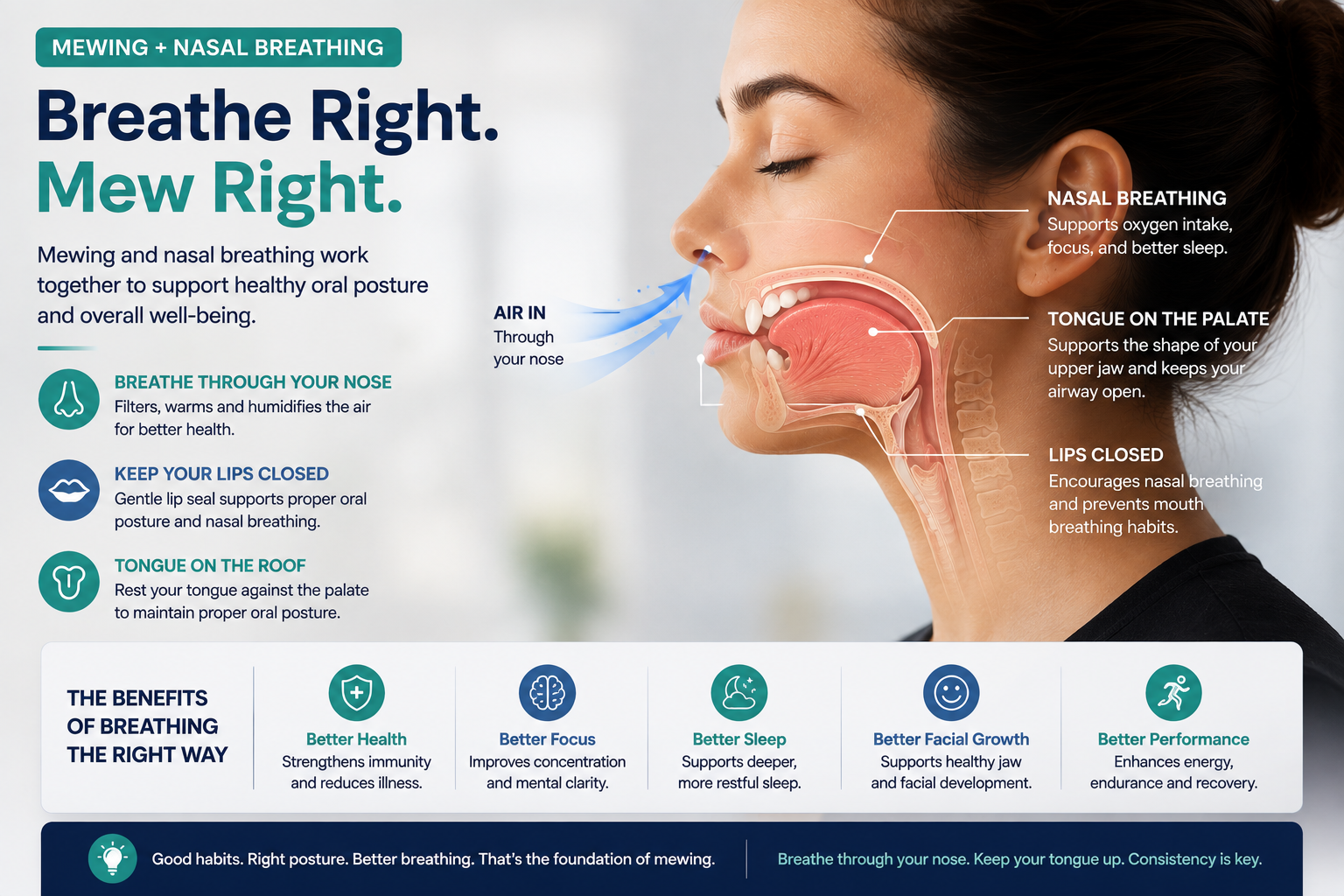
Once your tongue is resting comfortably against the palate and your lips are gently closed, breathing through your nose becomes part of the overall resting posture.
However, this does not mean you should force yourself to breathe through your nose if you cannot do so comfortably.
Why Nasal Breathing Matters
Mewing is not simply about where you place your tongue.
The overall posture also includes:
- Tongue position
- Lip posture
- Jaw relaxation
- Breathing habits
This is why learning correct tongue posture in isolation can sometimes feel incomplete.
If your natural habit is to rest with your mouth open, for example, you may need to become more aware of both your lip posture and breathing habits.
The aim is to develop a comfortable resting posture rather than constantly forcing your mouth into a particular position.
If you can breathe comfortably through your nose, nasal breathing fits naturally with gently closed lips and the tongue resting against the palate.
What If You Cannot Breathe Through Your Nose?
Do not ignore persistent difficulty breathing through your nose.
Nasal congestion, allergies and other underlying issues can make nasal breathing difficult. Simply trying harder to keep your mouth closed does not address the reason you are struggling to breathe.
If you regularly find that you cannot breathe comfortably through your nose, speak to an appropriate healthcare professional to understand the underlying cause.
You should never:
- Hold your breath to keep your mouth closed.
- Force your tongue into a position that restricts your breathing.
- Continue practising through significant discomfort.
- Assume persistent nasal obstruction can be solved simply by mewing.
Comfortable breathing always comes first.
Can You Mew With a Blocked Nose?
If your nose is temporarily blocked because of a cold or another short-term issue, focus on breathing comfortably rather than forcing your mouth closed.
If nasal blockage is persistent or regularly affects your ability to breathe, it is important to investigate why.
Mewing should not be used as a substitute for identifying and addressing an underlying breathing problem.
How Do You Know If You Are Mewing Correctly?
One of the biggest frustrations for beginners is not knowing whether they have found the correct position.
You cannot always see what your tongue is doing, and constantly checking it can make the whole process feel more complicated than it needs to be.
Instead of looking for one dramatic sign, use a simple self-check.
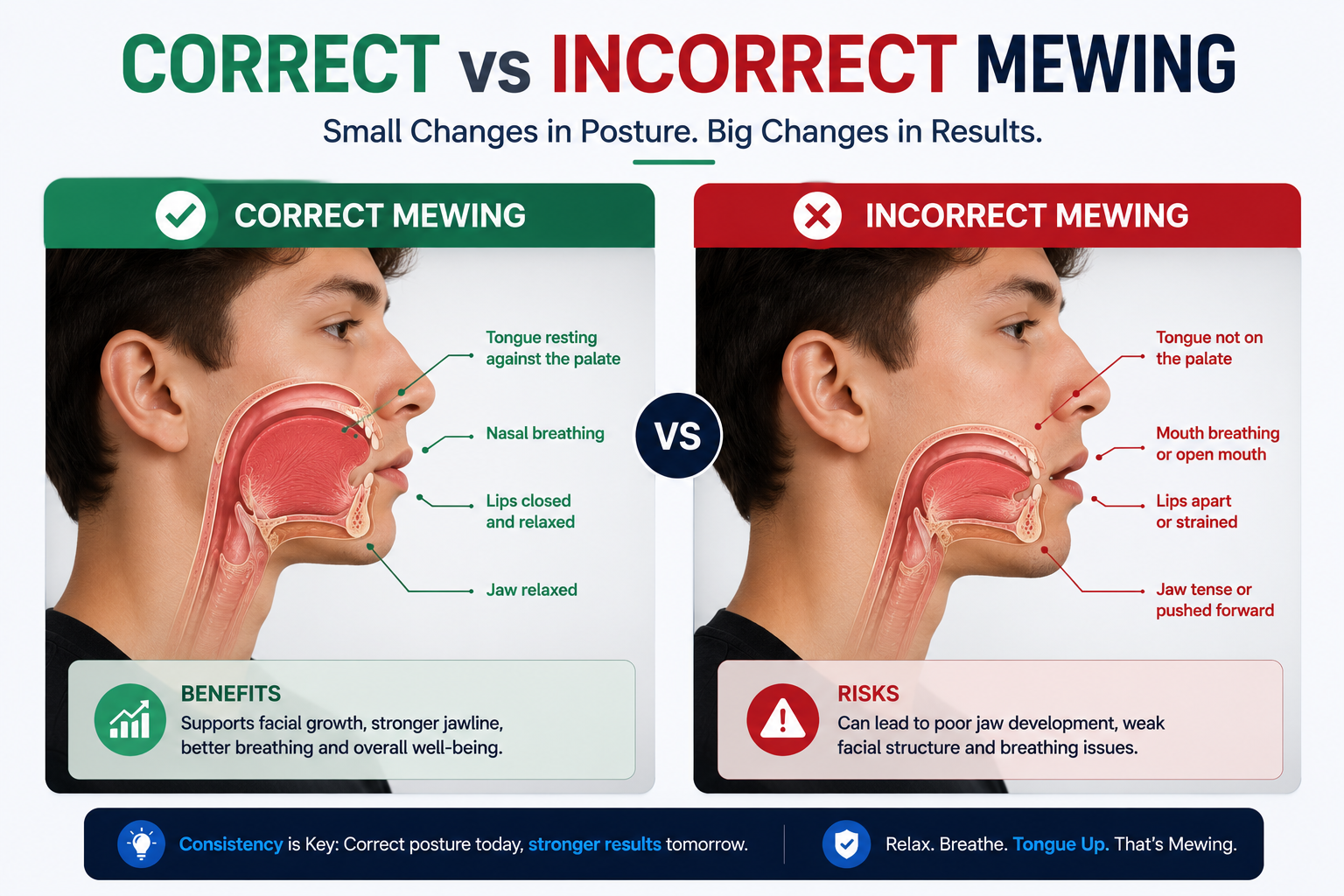
Check Your Tongue Position
Ask yourself:
Is my tongue resting against the palate comfortably?
The tip should be positioned behind your upper front teeth rather than pressing against them.
The middle and back portions of the tongue should also be encouraged towards the palate as comfortably as possible.
You should not need to create painful pressure to maintain the position.
Check Your Lips
Your lips should be gently closed.
Avoid squeezing or tightly pursing them.
A relaxed lip seal is the goal.
If your lips feel as though they are working hard to stay closed, relax and check whether you are creating unnecessary tension.
Check Your Jaw
Your jaw should feel relaxed.
Do not clench your teeth in an attempt to make the position feel more secure.
If you notice tension building in your jaw, face or neck, reset and return to a more relaxed position.
Check Your Breathing
You should be able to breathe comfortably.
If nasal breathing feels natural and unobstructed, maintain your relaxed posture.
If you are struggling to breathe, do not continue forcing the position.
Check Your Comfort
This is one of the simplest checks of all.
Correct practice should not cause ongoing pain or significant strain.
At first, the position may feel unfamiliar because you are becoming conscious of something you may never have thought about before.
Unfamiliar is not necessarily the same as uncomfortable.
A new position can feel unusual while you are learning it. Pain, excessive strain or difficulty breathing are different and should not be ignored.
Quick Self-Check
- ✓ My tongue is resting comfortably against my palate.
- ✓ My tongue tip is behind my upper front teeth.
- ✓ I am not pushing my tongue against my teeth.
- ✓ My lips are gently closed.
- ✓ My jaw is relaxed.
- ✓ I am not clenching my teeth.
- ✓ I can breathe comfortably.
- ✓ I am not using excessive force.
If these fundamentals are in place, you are focusing on the basic principles of correct mewing technique.
Common Mewing Mistakes Beginners Make
Learning how to mew correctly often involves recognising what not to do.
Many beginner mistakes come from trying too hard rather than not trying hard enough.
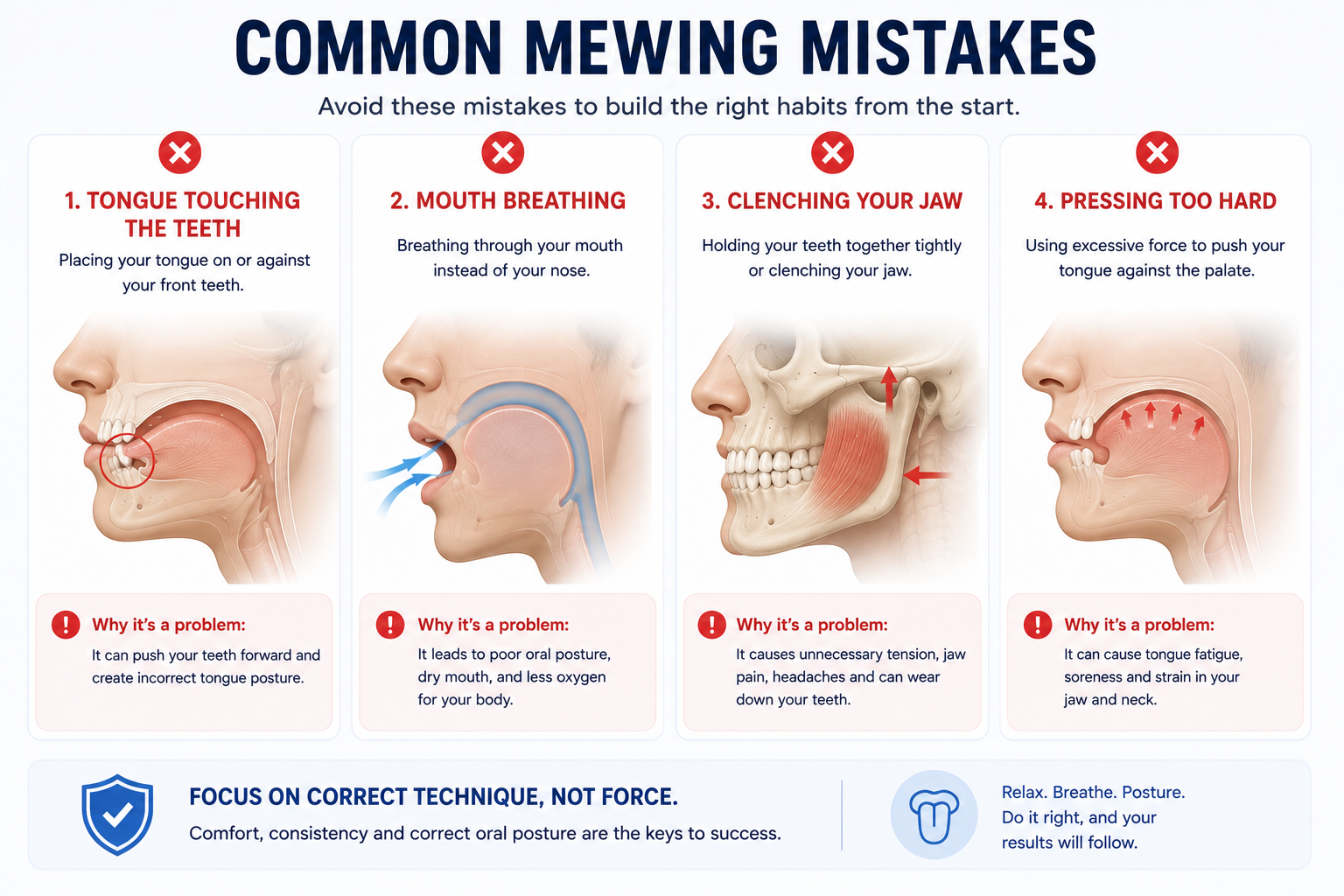
Pressing Your Tongue Too Hard
More pressure does not automatically mean better technique.
Mewing should not feel like an intense exercise that requires you to push your tongue upwards with maximum force.
If you are constantly straining, reset your position.
Focus first on where your tongue is resting rather than how hard you can press it.
Only Lifting the Tip of Your Tongue
It is easy to focus on the tongue tip because it is the easiest part of the tongue to feel.
However, correct oral posture involves more than placing the tip behind the upper front teeth.
The middle and back portions of the tongue are also important parts of the overall position.
If you are unsure about the back of your tongue, use the "NG" sound method described earlier to help recognise the sensation.
Pushing Against Your Front Teeth
Your tongue tip should rest behind your upper front teeth, not press directly into them.
Avoid turning tongue posture into forward pressure against the teeth.
If you notice yourself pushing forwards, relax and reposition the tongue.
Clenching Your Jaw
Some beginners clench their teeth because they believe it helps hold the tongue in place.
It does not.
The goal is relaxed oral posture.
If your jaw is constantly tense, you are likely using more effort than necessary.
Forcing Nasal Breathing
Nasal breathing should be comfortable.
If your nose is blocked or you have persistent difficulty breathing through it, forcing your mouth closed is not the answer.
Address the underlying issue rather than treating breathing discomfort as something you simply need to push through.
Constantly Checking Your Position
At the beginning, awareness is useful.
But checking every few seconds can create unnecessary tension and make the process feel exhausting.
You do not need to monitor your tongue every moment of the day.
Notice your posture, reset when necessary and gradually allow the position to become more familiar.
Expecting Immediate Results
Learning a new resting posture is a process.
You may become more aware of your tongue position quickly, but that does not mean every aspect of the habit will immediately feel automatic.
Focus on learning the technique correctly and practising consistently.
Avoid setting arbitrary deadlines for when the posture should feel completely natural.
For a more detailed look at incorrect technique, common problems and how to avoid them, see our upcoming guide to Common Mewing Mistakes.
How to Make Mewing a Daily Habit
Understanding the correct position is only the first step.
The real challenge is remembering it often enough for it to become more familiar.
The key is not to spend the entire day actively forcing your tongue into position.
Instead, build awareness gradually.
Start by Building Awareness
At first, simply notice where your tongue naturally rests.
You may discover that you have never consciously paid attention to it before.
Several times throughout the day, pause and ask:
Where is my tongue resting right now?
If it has dropped into a position you are trying to change, calmly reset it.
There is no need to criticise yourself or start forcing the position.
Awareness comes first.
Use Everyday Reminders
Choose normal moments during the day as reminders to check your posture.
- When you sit down at your desk.
- When you open your laptop.
- When you pick up your phone.
- When you start walking.
- When you get into the car.
- When you take a break from work.
These moments can act as simple cues.
Over time, you may find yourself checking your posture naturally without needing constant reminders.
Reset Instead of Forcing
Your tongue will not remain perfectly positioned every second, especially while you are learning.
You may speak, eat, drink, laugh or simply lose awareness of your posture.
That is normal.
When you notice the position has changed:
- Relax.
- Find the correct tongue position again.
- Close your lips gently.
- Check that your jaw is relaxed.
- Continue breathing comfortably.
Then move on with your day.
Do not turn every reset into a forceful correction.
Focus on Consistency
Consistency is more useful than intensity.
A relaxed position that you regularly return to is more sustainable than repeatedly forcing your tongue upwards for short periods.
The long-term aim is for greater awareness of your oral posture and for the correct position to become increasingly familiar.
How Long Does It Take to Learn Mewing?
There is no single answer.
Some people may understand the basic tongue position quickly but find it difficult to remember throughout the day.
Others may struggle initially to recognise the position of the middle or back of their tongue.
Your experience can depend on your existing habits, awareness and how unfamiliar the position feels to you.
Why Does It Feel Awkward at First?
Your tongue already has a habitual resting position.
Even if you have never consciously thought about it, your body is used to that position.
Changing your awareness can therefore feel strange initially.
You may find yourself repeatedly asking:
Is my tongue really in the right place?
That uncertainty is common when learning.
Use the self-check from this article, practise the basic position and avoid constantly chasing a "perfect" sensation.
When Does the Position Start Feeling More Natural?
There is no reliable timeframe that applies to everyone.
Rather than measuring your progress by a specific number of days, look for gradual improvements in awareness.
- You remember to check your posture more often.
- Finding the tongue position becomes easier.
- You need less time to reset.
- The position feels less unfamiliar.
- You use less conscious effort.
These are more useful signs of learning than expecting a particular result by a specific date.
Why Everyone's Learning Process Is Different
Everyone starts from a different point.
Existing oral habits, breathing patterns, individual anatomy and general awareness can all affect how easy or difficult a new posture feels.
This is why generic promises such as "master mewing in seven days" should be treated cautiously.
The focus should remain on learning the basics correctly and allowing consistency to develop over time.
Can You Mew If You Have Braces or Dental Issues?
If you have braces, orthodontic appliances, a significant bite problem or ongoing jaw discomfort, it is important to approach mewing carefully.
Mewing should not be used to try to move your teeth or change your bite by applying additional pressure with your tongue.
Your orthodontic treatment has been designed around your individual dental and facial structure. If you are currently receiving orthodontic treatment, ask your orthodontist or dentist whether practising a particular oral posture is appropriate for you.
Mewing With Braces
Having braces does not mean you should stop paying attention to your natural oral posture.
However, you should not deliberately press your tongue against your braces or teeth in an attempt to accelerate movement.
Your orthodontist is the right person to advise you about how your tongue posture, bite and treatment interact.
If you experience new discomfort after changing your oral posture, stop forcing the position and discuss it with your dental professional.
Existing Bite Problems
If you have an overbite, underbite, crossbite, open bite or another significant bite concern, do not attempt to correct it yourself by changing the position of your tongue or jaw.
Mewing is not a substitute for professional orthodontic or dental assessment.
The same applies if you regularly experience:
- Jaw pain
- Clicking or locking of the jaw
- Tooth pain
- Significant dental sensitivity
- Difficulty opening or closing your mouth
- Persistent difficulty breathing through your nose
These symptoms deserve appropriate professional assessment.
When Should You Speak to a Dental Professional?
A useful rule is simple:
If something hurts, feels abnormal or is affecting your ability to eat, speak or breathe comfortably, don't try to push through it.
Learning oral posture should not involve ignoring symptoms that may have another underlying cause.
Can the Mewing App Help You Learn Correct Technique?
Learning the basic concept of mewing is relatively simple.
Learning to recognise and maintain the correct position consistently can be more difficult.
There is a lot of conflicting information online, particularly around tongue placement, pressure, breathing and how often you should practise.
A structured learning approach can make the process easier to follow.
Structured Lessons
The Mewing App provides structured educational lessons designed to guide users through the fundamentals rather than leaving them to piece together information from unrelated videos and social media posts.
This is particularly useful for beginners who are still learning to recognise the correct tongue position.
Guided Learning
Instead of constantly wondering whether you are doing something correctly, guided lessons provide a clear progression through the fundamentals.
The focus should remain on understanding:
- Tongue posture
- Lip posture
- Nasal breathing
- Relaxed jaw position
- Consistency
Progress Tracking
Learning a new habit can be difficult when there is no structure.
Progress tracking gives users a way to maintain awareness of their learning and stay consistent with their routine.
The purpose of tracking should not be to promise a particular facial transformation.
Instead, it is about helping you stay engaged with the learning process.
Building Consistency
The biggest challenge for many beginners is not understanding the basic instruction.
It is remembering to apply it consistently.
The Mewing App is designed to provide a structured environment where users can continue learning, practising and developing their awareness over time.
Want structured guidance instead of trying to piece everything together from social media?
Quick Mewing Checklist
Use this checklist whenever you want to reset your oral posture.
Before You Start
- Relax your jaw.
- Close your lips gently.
- Find the correct tongue position.
- Make sure your tongue tip is behind your upper front teeth.
- Check that you are breathing comfortably.
While Practising
- Keep the tongue relaxed.
- Allow as much of the tongue as comfortably possible to rest against the palate.
- Avoid pushing against your front teeth.
- Do not clench your jaw.
- Do not use excessive force.
- Do not force nasal breathing if your nose is obstructed.
- Reset calmly when you notice your posture has changed.
Remember
Correct position first. Consistency second. Force is not the goal.
Frequently Asked Questions About How to Mew
How do I know if I am mewing correctly?
Start with the basic checks. Your tongue should be resting comfortably against the palate, with the tip behind your upper front teeth rather than pushing against them. Your lips should be gently closed, your jaw should remain relaxed and you should be able to breathe comfortably through your nose.
You should not need to clench your teeth or apply excessive pressure with your tongue.
If the position feels unfamiliar when you first begin, that does not necessarily mean you are doing it incorrectly. You are becoming aware of a resting posture that you may never have consciously considered before.
Use the checklist in this guide to reset your position rather than constantly trying to achieve a perfect sensation.
Where should my tongue sit when mewing?
The tongue should rest against the roof of your mouth as comfortably as possible. The tip should sit on the palate behind your upper front teeth rather than pressing directly against them.
The middle and back portions of the tongue should also be encouraged towards the palate.
One useful way to become familiar with the back portion is to make the final "NG" sound in a word such as "sing". This can help you recognise the movement and sensation of the back of the tongue.
Once you have found the position, relax rather than continuing to force the tongue upwards.
Should my whole tongue touch the roof of my mouth?
The general principle taught in the Mewing App's educational material is to develop contact between the tongue and palate across as much of the tongue as can be achieved comfortably, including awareness of the posterior portion.
However, beginners should not interpret this as a reason to apply maximum pressure.
If you currently struggle to feel the back of your tongue, work on becoming familiar with the position gradually.
The objective is to develop a comfortable resting posture, not to force every part of the tongue upwards.
Should my tongue touch my teeth when mewing?
The tongue tip should not be pressing against your upper front teeth.
Instead, position the tip on the palate just behind them.
If you notice your tongue pushing forwards into your teeth, relax the tongue and move the tip slightly backwards.
Mewing should not involve deliberately applying forward pressure to the teeth.
Should my teeth touch when mewing?
The important point is to keep your jaw relaxed and avoid clenching.
You should not deliberately squeeze your upper and lower teeth together to hold your tongue in place.
The exact resting relationship between the teeth can vary, and forcing a particular tooth position is unnecessary.
If you have an existing bite problem, orthodontic treatment or jaw discomfort, speak with your dentist or orthodontist rather than attempting to change your bite through mewing.
Should I clench my jaw while mewing?
No.
Clenching your jaw is not necessary for correct mewing.
The aim is relaxed oral posture, not increased muscular tension.
If you notice that your jaw, temples, face or neck are becoming tense while practising, stop and reset.
Trying to create more pressure does not make the technique more correct.
How much pressure should I use when mewing?
Mewing should not be treated as a strength exercise.
Use only the amount of effort needed to maintain a comfortable resting tongue position.
If you are consciously pushing your tongue as hard as possible against the palate, you are likely focusing on force rather than posture.
The goal is to gradually make the correct position more natural and sustainable.
Pain, significant tension or discomfort are signs to stop forcing the position.
How do I get the back of my tongue up?
The back of the tongue is often the most difficult part for beginners to recognise.
Try making the final "NG" sound in words such as "sing" or "king". Notice how the back of your tongue moves upwards.
Once you recognise that sensation, stop making the sound and try to maintain a similar position while relaxing your jaw and breathing normally.
Do not force the back of your tongue upwards if doing so makes breathing difficult or creates excessive tension.
With practice, awareness of this part of the tongue can become easier.
Why can't I keep my tongue on the roof of my mouth?
There can be several reasons.
You may simply be unfamiliar with the position, or you may be focusing too much on actively holding your tongue there.
Start by relaxing your jaw and using the "NG" sound method to find the position again.
If you consistently cannot maintain the position comfortably, or if nasal breathing is difficult, don't force it.
Persistent difficulty with tongue posture or nasal breathing may warrant professional assessment.
Learning the technique should be gradual.
Can I breathe normally while mewing?
Yes. Comfortable breathing is important.
Mewing should not prevent you from breathing normally through your nose.
If you find yourself struggling to breathe, do not respond by forcing your tongue higher or holding your mouth closed.
Instead, check whether your nose is obstructed or whether another issue is making nasal breathing difficult.
If the problem is persistent, speak with an appropriate healthcare professional.
Can I talk while mewing?
Yes.
Mewing refers primarily to resting oral posture, not to keeping your mouth and tongue completely still.
When you speak, eat or drink, your tongue and jaw naturally move.
Once you finish, your mouth can return to its comfortable resting position.
You therefore do not need to try to maintain the exact same tongue position while speaking.
Can I mew while sleeping?
Mewing is intended to develop a natural resting posture rather than something you should consciously force while asleep.
The more familiar a healthy resting posture becomes while you are awake, the more natural it may become over time.
However, you should not use devices, tape or other methods to force your mouth closed while sleeping without appropriate professional guidance.
If you regularly wake with a dry mouth, suspect that you breathe through your mouth at night or have difficulty breathing through your nose during sleep, discuss this with a healthcare professional.
How long should I practise mewing each day?
There is no need to treat mewing as a short exercise with a fixed daily duration.
The broader aim is to become aware of your resting oral posture and gradually develop more consistent habits throughout your normal day.
You can use everyday activities as reminders to check your posture, such as sitting at your desk, walking or using your phone.
The focus should be on consistency and comfort rather than spending a specific number of minutes applying pressure.
Why does mewing feel uncomfortable at first?
A new resting position can feel unfamiliar because you may have had the same oral posture for many years without thinking about it.
Some initial unfamiliarity is normal.
However, persistent pain is different.
Mewing should not cause ongoing jaw pain, dental discomfort, significant neck tension or difficulty breathing.
If you experience these symptoms, stop forcing the position and seek appropriate professional advice.
What should I do if mewing causes jaw pain?
Stop forcing the technique.
Mewing should not require you to clench your teeth or create excessive tension in your jaw.
If the discomfort disappears when you relax your jaw and stop applying pressure, you may have been using too much force.
If pain continues, returns frequently or is accompanied by clicking, locking or difficulty moving your jaw, speak with a dentist or other qualified healthcare professional.
Do not attempt to work through persistent pain in the hope that it will produce better results.
Can I mew with braces?
If you have braces, you should follow the instructions provided by your orthodontist.
Do not use mewing as a way to deliberately apply additional pressure to your teeth or attempt to accelerate orthodontic movement.
If you are interested in practising oral posture while undergoing treatment, ask your orthodontist whether it is appropriate for your particular situation.
Your dental treatment and individual bite should always take priority over generic instructions found online.
Is hard mewing better than gentle mewing?
No.
The idea that more force automatically produces better results is one of the biggest misconceptions surrounding mewing.
Correct mewing is about learning a comfortable resting posture.
Applying excessive pressure can create unnecessary tension and may contribute to unwanted dental or bite changes.
Focus on correct positioning and consistency rather than trying to make the tongue work harder.
How long does it take to learn correct mewing?
There is no universal timeframe.
Some people may become comfortable with the basic position relatively quickly, while others need more time to recognise and maintain the middle and back portions of the tongue.
Your existing habits, awareness, breathing patterns and individual anatomy can all affect the learning process.
Instead of setting a deadline, look for gradual improvements in awareness and consistency.
Can an app help me learn how to mew?
Yes, a structured learning app can make the process easier by bringing lessons, guidance and progress tracking into one place.
The Mewing App is designed to help users learn the fundamentals progressively rather than relying on disconnected social media videos and conflicting instructions.
It can be particularly useful for beginners who want a structured routine and a clear way to continue learning over time.
What should I do if I cannot breathe through my nose while mewing?
Do not force the position.
If you cannot breathe comfortably through your nose, keeping your mouth closed or pushing your tongue higher is not a solution to the underlying problem.
Temporary congestion may resolve naturally, but persistent nasal obstruction should be assessed by an appropriate healthcare professional.
The goal is comfortable breathing and healthy oral posture, not holding a position at the expense of your ability to breathe normally.
Final Thoughts
Learning how to mew correctly is less about mastering a complicated exercise and more about understanding the fundamentals of oral posture.
Start with the basics:
Relax your jaw.
Close your lips gently.
Position your tongue against the palate.
Keep the tongue tip behind your upper front teeth.
Breathe comfortably through your nose.
Avoid excessive pressure.
Then practise.
You will probably lose the position at times. You may forget about it while working, talking or concentrating on something else.
That's normal.
When you notice, simply reset.
The objective is not to spend every waking moment consciously controlling your tongue. It is to gradually develop greater awareness of your oral posture and make the correct position more familiar and sustainable.
Most importantly, don't let the internet convince you that harder always means better.
Mewing should not be painful, and it should not involve forcing your teeth, jaw or tongue into uncomfortable positions.
Learn the fundamentals, practise them consistently and keep your expectations realistic.
Start Learning Mewing With Structured Guidance
If you want to learn the fundamentals step by step rather than relying on random videos and conflicting advice online, the Mewing App provides structured lessons, guided learning and progress tracking to help you build consistent oral posture habits.
Start your free trial with the Mewing App today.

Mike Mew
Mike Mew is the British founder of mewing, known for his innovative approach to improving facial structure and oral posture naturally. He is a leading pioneer of Orthotropics, an approach developed by his father, Professor John Mew.
Related posts
22 min read
What Is Mewing? The Complete Beginner's Guide
A complete beginner's guide to mewing, covering correct tongue posture, oral posture, nasal breathing, the origins of Orthotropics, realistic expectations and how to build consistent habits.
By Mike Mew

3 min read
The Great Mewing Event
Mike Mew has officially announced The Great Mewing Event, set to take place on 6th September at Logan Hall.
By Mike Mew

2 min read
Gesichtsformen einfach erklärt: So findest du deine!
Deine Gesichtsform hilft dir dabei, den besten Haarschnitt, die passende Brille oder das richtige Make-up zu finden. In diesem Artikel zeigen wir dir Schritt für Schritt, wie du deine Gesichtsform bestimmst – ganz einfach!
By Henry
